SEO pricing in Nepal runs from a few thousand rupees for a one-off fix to tens of thousands a month for ongoing work. That range is wide, and most agencies don’t post their prices, so comparing offers is hard.
We do post ours. This page shows what our plans cost, what you get for the money, and what pushes a price up or down. Even if you don’t hire us, you can use it to judge any quote you get.
SEO pricing in Nepal at a glance
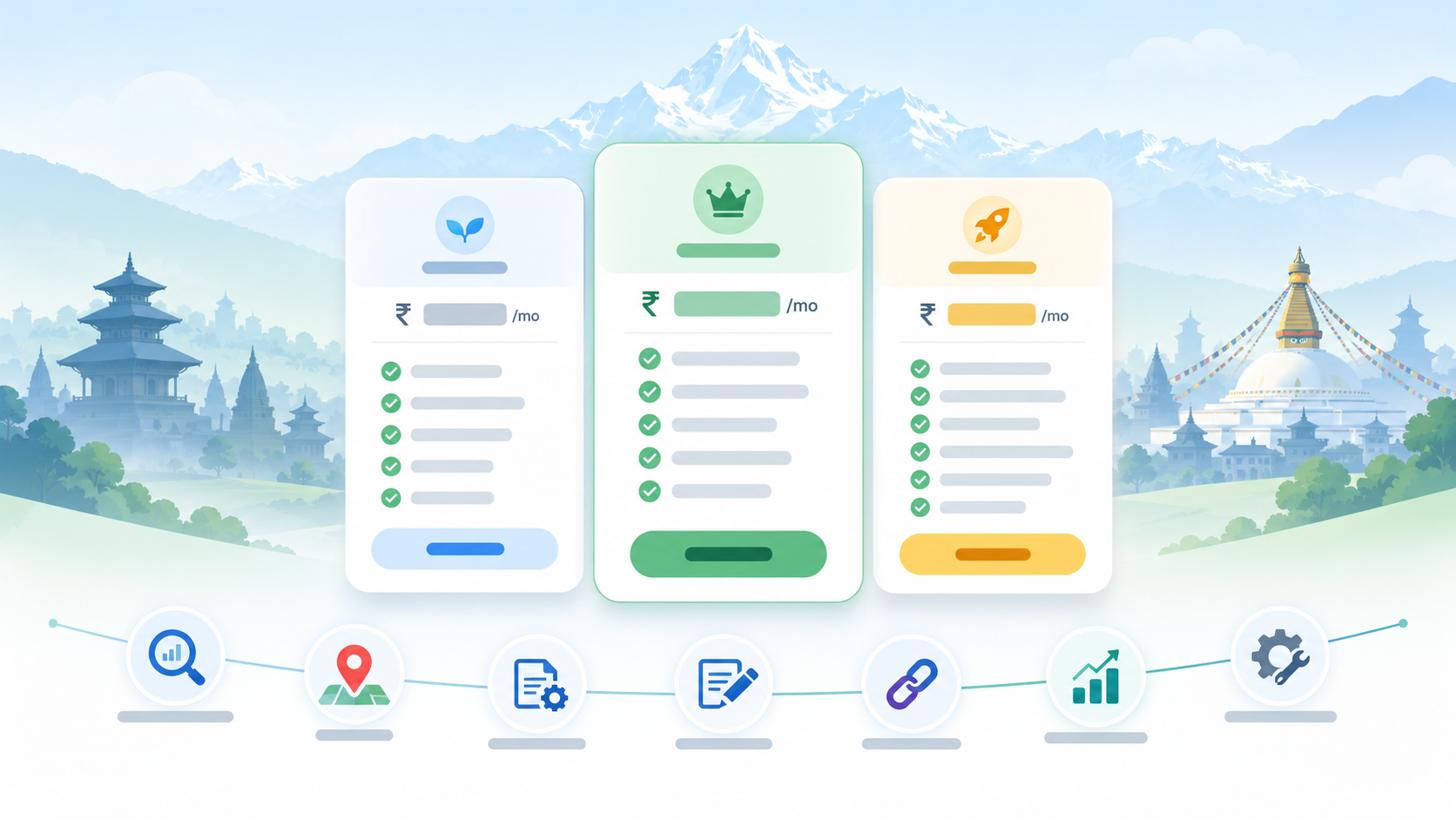
These are the monthly plans on our SEO package page. Every plan has a three-month minimum.
| Standard | Professional | Premium | |
|---|---|---|---|
| Price per month | NPR 34,000 | NPR 56,000 | NPR 88,000 |
| Made for | Small businesses | Mid-size businesses | Growth teams |
| Keywords researched | Up to 10 | Up to 20 | Up to 40 |
| Pages optimized | Up to 5 | Up to 10 | Up to 15 |
| Blog articles a month | 2 | 4 | 6 |
| Backlinks a month | Up to 3 | Up to 6 | Up to 10 |
| Local citations | Up to 10 | Up to 20 | Up to 30 |
There is also a Custom plan for very competitive markets. It has no fixed price because the scope depends on your site and your rivals.
All three plans share the same base: a website audit, Google Analytics and Search Console setup, a robots.txt file, an XML sitemap, technical fixes, schema markup, Google Business Profile work, and a monthly report. The difference is volume. Going from Standard to Professional adds NPR 22,000 and roughly doubles the work.
What changes the price of SEO
Two shops can both ask for “SEO” and need very different amounts of work. These are the things that move the price.
Competition comes first. Ranking for “dentist in Lalitpur” is easier than ranking for “web hosting in Nepal,” because fewer sites fight over it. The harder the keyword, the more content and links it takes.
Site size matters next. A five-page site is quick to audit. A shop with 800 products has more pages to fix and more duplicate URLs to sort out.
The condition of your site counts too. A site that loads slowly, has broken pages, or blocks Google by mistake needs repairs before anything else will work.
Then there is content. Each blog post or service page takes a writer’s time. And links cost money because good ones take outreach. If you only serve one town, local SEO is cheaper than trying to rank across all of Nepal.
How SEO companies charge
Most companies use one of four models.
A monthly retainer is the most common. You pay a fixed amount each month for ongoing work, which is how our plans run. It suits SEO well, because the work builds on itself.
A one-off project, like an audit or a site fix, has a single price. It’s useful when you want a list of problems and plan to fix them yourself.
Some people charge by the hour. It can work for small jobs, but it makes the final bill hard to guess.
Some agencies offer pay-for-results deals. Be careful here. No one controls Google, so a deal tied to a fixed ranking often leads to shortcuts that can hurt your site.
What the Standard plan includes
The Standard plan costs NPR 34,000 a month, and it’s the one most small businesses start with. Here is what the money covers, in plain words.
In the first month, we audit your site and find what is broken. We pick up to 10 keywords your customers use, and match each to a page. We also set up Google Analytics and Search Console so you can see real numbers.
Then comes the repair work. For on-page SEO, we rewrite titles, headings, and descriptions on up to five key pages, fix URLs, compress images, and improve internal links. For technical SEO, we fix broken links and redirects and check that your site works on phones.
Each month we also write two articles, which is part of our content marketing work. For off-page SEO, we build up to three good backlinks. Our local SEO service in Nepal sets up your Google Business Profile and adds up to 10 local citations. At the end of each month, you get a report with your traffic, your top pages, and your keyword positions.
Which plan should you pick?
Start from the size of your site and the number of searches you want to win.
If your site has under 15 pages and you serve one town or one niche, Standard is usually enough. If you have more services, a bigger blog plan, or you compete with several strong sites, Professional gives you more keywords and twice the monthly content. Premium fits a larger site that needs many pages fixed and a steady stream of new ones.
You aren’t locked into one level. You can move up later as your site grows. If you aren’t sure, contact us, and we’ll tell you which plan fits. Sometimes the honest answer is the cheaper one.
Why SEO needs at least three months
Our plans have a three-month minimum, and there is a reason. In the first weeks, we find and fix problems. Google then needs time to crawl the changes and decide where your pages belong.
Most sites see a first improvement in 4 to 8 weeks. Stronger, steadier growth usually shows around the 3 to 6 month mark, and it depends on your competition. A company that promises page one in a week is guessing or lying. You can read more on how growth builds in our post on SEO growth.
Is SEO worth the price?
Think of the cost as the cost of getting customers, not as a bill. Here is an example with made-up numbers, so swap in your own.
Say you sell kitchen renovations, and each new customer brings you NPR 20,000 in profit. Three months of Standard costs NPR 102,000 (3 × 34,000). You would need about six new customers from search to break even over that time.
That may not happen in the first three months. SEO builds slowly, so the payback often comes later, when the pages are ranking, and the monthly cost stays flat. Compare it with ads, where the cost keeps going, and the visitors stop when you stop paying.
Warning signs of cheap SEO
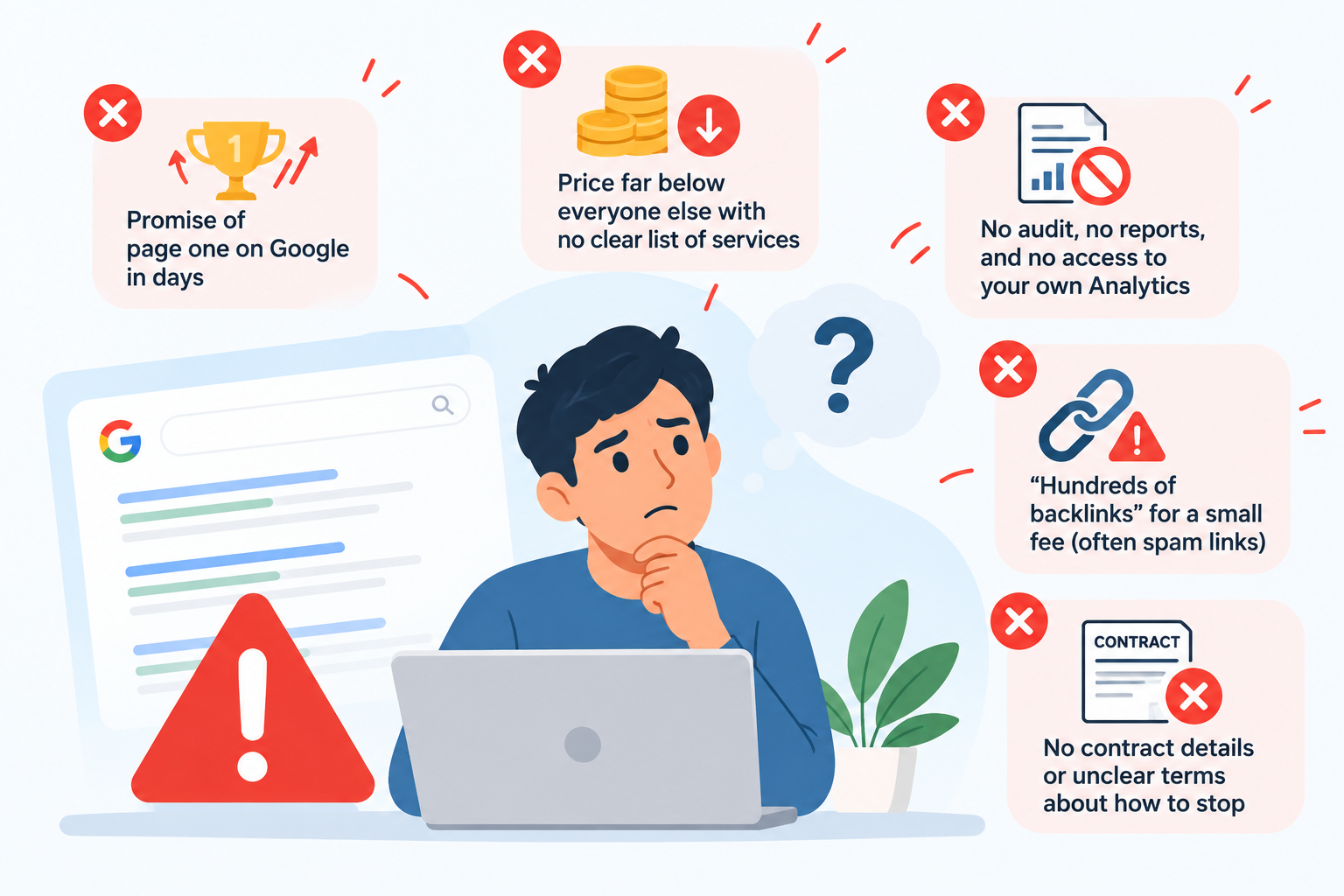
Low prices aren’t always a trap, but be careful when you see these:
- a promise of page one on Google in days
- a price far below everyone else, with no list of what you get
- no audit, no reports, and no access to your own Analytics account
- “hundreds of backlinks” for a small fee, which often means spam links that can hurt your site
- no contract details, or one that is unclear about how to stop
Google has its own advice on hiring an SEO, and it’s worth five minutes before you sign.
Questions to ask before you pay
- What exactly is included each month? Ask for a list, not a sentence.
- How many pages and keywords will you work on?
- Who will write the content, and who checks it?
- Will I get a report every month, and can I see my own Search Console?
- What is the minimum time, and how do I stop if it isn’t working?
A good company answers all five without fuss. Our SEO company in Nepal guide has more questions, and our post on SEO services in Nepal explains what an expert does day to day.
Cost of SEO for a new website
If you are building a new site, plan the SEO from the start. It’s cheaper to set up clean URLs, fast pages, and proper titles at the beginning than to fix them later. See our website development pricing for how we handle this.
SEO pricing FAQ
How much does SEO cost in Nepal?
It depends on your site and your competition. Our monthly plans run from NPR 34,000 to NPR 88,000, and a Custom plan is available for tough markets. Other companies price differently, so ask each one what is included.
Is there a cheaper way to start?
You can do the basics yourself for free. Set up a Google Business Profile, open Search Console, and fix your page titles. Google’s SEO starter guide walks through it.
Do I have to sign a long contract?
Our plans have a three-month minimum. After that, the plan continues month to month.
Do you guarantee a number one ranking?
No, and no honest company can. We work on steady improvements in rankings, traffic, and leads.
Can I change my plan later?
Yes. You can move up as your site and budget grow.
What do I need to give you to start?
We need access to your website and analytics, plus a short chat about your goals and customers.
Get a price for your own site.
Not sure which plan fits? Tell us about your site on the contact page or look through our case studies first. We’ll reply within one business day and say which plan makes sense, even if the answer is a smaller one.