E-E-A-T SEO is about giving people good reasons to trust the information, the person or team behind it, and the business publishing it. The framework stands for Experience, Expertise, Authoritativeness, and Trustworthiness. It is especially relevant when a search result could influence someone’s health, finances, safety, or other important decisions, but the principles are useful for every business website.
For a business in Nepal, this means more than adding an author name or placing “expert” in a page title. Your website should show who created its content, what practical knowledge supports it, where important claims come from, and how a visitor can verify that your business is real and accountable.
This guide explains what E-E-A-T means in SEO, what Google actually says about it, and how to turn the principles into practical improvements for service pages, blog posts and business websites.
What is E-E-A-T in SEO?
E-E-A-T stands for Experience, Expertise, Authoritativeness,s and Trustworthiness. It is a concept described in Google’s Search Quality Rater Guidelines. Google’s quality raters use the guidelines to evaluate the quality of search results and provide feedback that helps Google assess its systems.
One important distinction: E-E-A-T is not a single Google ranking factor or a score you can switch on. Google says its automated ranking systems use a range of signals to identify helpful, reliable information. E-E-A-T describes qualities that can help people and evaluators understand whether a page and its creator deserve trust.
Trust is the central element. Experience, expertise,se and authority help establish why a source should be trusted, while accuracy, transparency,ncy and a safe user experience help maintain that trust.
The four parts of E-E-A-T explained
1. Experience: show first-hand knowledge
Experience means the content reflects genuine first-hand involvement with the subject. A business explaining a process it has actually carried out can provide details that a page assembled from other articles cannot.
For an SEO agency, useful evidence might include an anonymised audit example, a before-and-after technical issue, a screenshot of a real Search Console report with client information removed, or a clear explanation of what was tested and what changed. Do not invent results, client stories,ries or screenshots. If an example is hypothetical, label it as an example.
2. Expertise: demonstrate relevant knowledge
Expertise is the depth and accuracy of the information, together with the knowledge of the people who create or review it. Formal qualifications can matter for some subjects, especially health, finance, nance and legal advice. For many business and marketing topics, practical competence, accurate explanations and verifiable work are also important.
Make authorship clear. Add a real author name, a short biography that accurately describes their role and experience, and a reviewer where specialist review genuinely took place. Avoid invented credentials or vague claims such as “leading expert” without evidence.
3. Authoritativeness: become a recognised source
Authoritativeness is the reputation a creator, organisation or website earns within a topic. It develops over time when useful work is referenced, cited, discussed, and recommended by relevant people and publications.
Build authority by publishing a connected set of genuinely useful resources, contributing expert commentary, earning relevant editorial mentions, and showing the people and work behind your business. Relevant links and mentions can support reputation, but buying links or pursuing unrelated directory listings is not a substitute for credibility.
4. Trustworthiness: make claims easy to verify
Trustworthiness is the most important part of E-E-A-T. Visitors should be able to understand who operates the website, how to contact the business, what a service includes, and whether the information is accurate and current.
Use HTTPS, publish clear contact and business information, explain policies and limitations, cite reliable sources, disclose commercial relationships where relevant, and correct outdated or inaccurate information. Keep your business details consistent across your website and important public profiles.
Why does E-E-A-T matter for SEO?
People need reliable answers, and Google’s guidance asks creators to focus on helpful, people-first content rather than pages made primarily to manipulate rankings. E-E-A-T provides a useful way to assess whether your content and website demonstrate the qualities readers need before acting on advice.
These principles are particularly important for topics that can affect a person’s money, health, safety or wellbeing, often called Your Money or Your Life (YMYL) topics. However, a local service provider also benefits when customers can verify its experience, understand its recommendations,s and contact a real business.
E-E-A-T should not be treated as a shortcut to higher rankings. Stronger trust signals cannot guarantee a position, and adding author schema alone will not make weak content authoritative. The goal is to make the website genuinely more useful and credible.
How to improve E-E-A-T on your website
1. Add useful author and reviewer information
Give each important article a byline that leads to a real author page. Explain the author’s relevant experience, areas of knowledge,ge and role in creating the article. If a qualified person reviewed the content, identify them and describe the scope of their review. Do not add a reviewer label when no review occurred.
2. Publish original examples and evidence
Replace generic statements with details from real work. For an SEO article, this could mean showing how you diagnose an indexing issue, explain a crawl finding, interpret a Search Console trend, or prioritise a content update. Remove client names, personal information,n and confidential data unless you have permission to publish them.
3. Cite primary and dependable sources
Link directly to original documentation when explaining Google’s policies or technical requirements. Use reliable research for statistics and make it clear when a point is your own recommendation rather than an official Google rule. Review outbound references periodically so readers are not sent to outdated or broken pages.
4. Build topical depth with helpful internal links
Organise your resources around the questions your audience needs answered. A guide about content quality can link naturally to a broader SEO content strategy, while technical explanations can point to a relevant technical SEO guide or website SEO audit checklist. Link only where the destination adds value; do not force exact-match anchors into every paragraph.
5. Make your business transparent
Maintain accurate About, Contact, service,ce and policy pages. Explain what your services include, who delivers them, how customers can ask questions, and what outcomes depend on factors outside your control. Use real testimonials and case studies only with permission and enough context to avoid misleading readers.
6. Keep content accurate and maintained
Review articles when Google’s documentation, tools, or industry practices change. Update facts, screenshots, examples,s and links, and show a meaningful updated date when the content has genuinely been reviewed. Changing a date without improving the page does not make it more useful.
7. Use structured data accurately
Relevant structured data can help search engines understand the entities and page details on your website. Use appropriate Organization, Person, Article, or other supported schema only when it accurately reflects visible page content. Structured data does not create expertise or guarantee rich results, and it should never contain fabricated credentials, ratings,s or reviews.
8. Earn recognition beyond your own website
Build relationships with relevant industry publications, professional communities, local business groups and partners. Share original research or practical resources that others may want to reference. Prioritise relevance and editorial quality over the raw number of backlinks.
E-E-A-T checklist for business websites
- Important pages identify the real author or responsible organisation.
- Author biographies describe genuine, relevant experience.
- Specialist reviews are clearly attributed and actually performed.
- Articles include original examples, evidence or useful analysis where appropriate.
- Important claims link to reliable, preferably primary, sources.
- About, Contact and service information is accurate and easy to find.
- Testimonials and case studies are genuine and used with permission.
- Content is reviewed when facts, products,t s or guidance change.
- Internal links connect related resources in a useful way.
- Structured data matches the visible content and real entities.
- Relevant third-party mentions and links are earned through useful contributions.
- HTTPS, privacy information, and basic site security are maintained.
How to evaluate E-E-A-T improvements
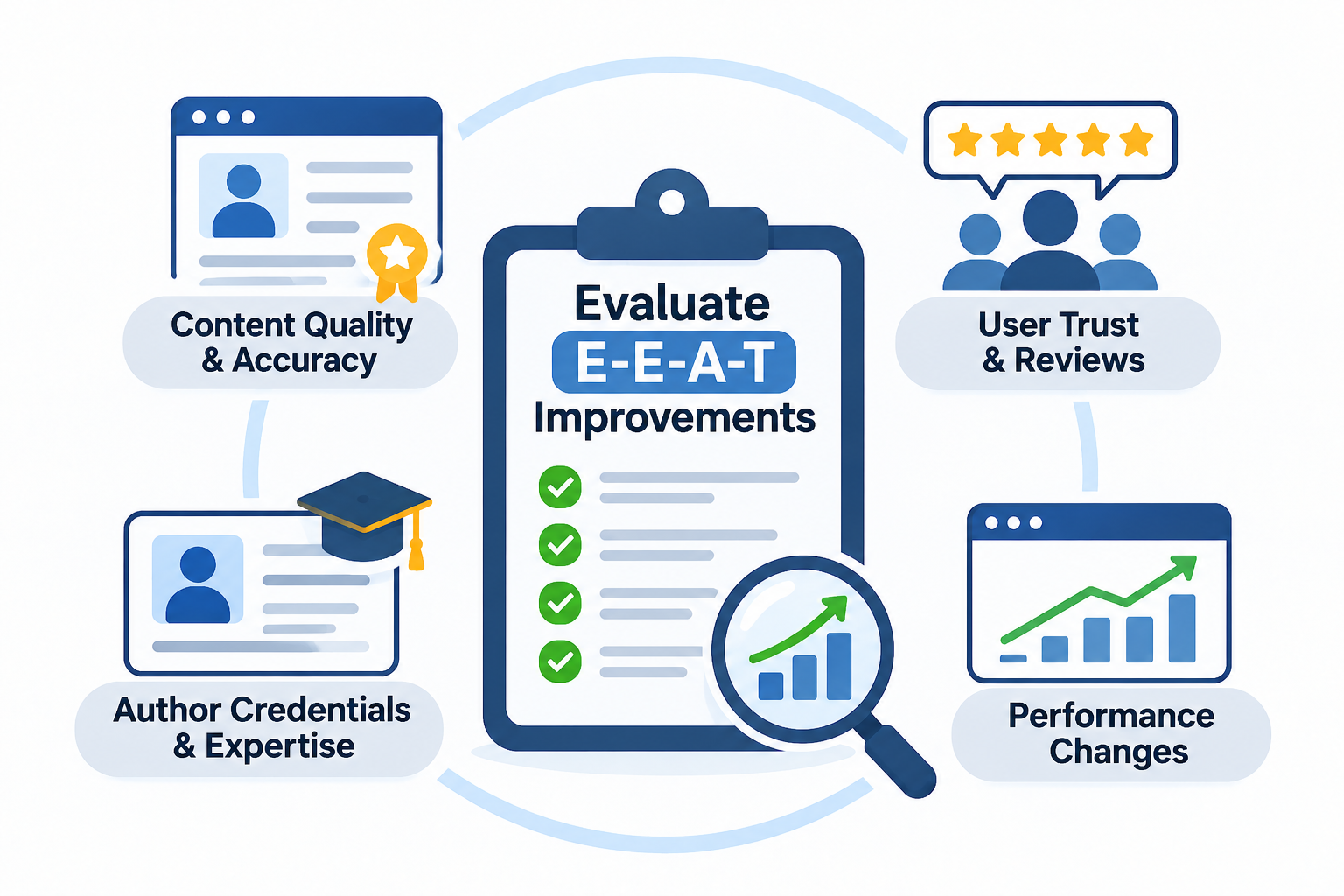
There is no official E-E-A-T score in Google Search Console. Instead, track practical indicators that show whether your work is making the website more useful and visible:
- Search Console: monitor relevant queries, impressions, clicks, click-through rate,e and average position for the pages you improve.
- Engagement and conversions: use analytics and lead tracking to understand whether visitors find the information useful and take appropriate next steps.
- Content quality: review author transparency, sourcing, originality, accuracy,cy and whether the page answers the searcher’s question.
- Reputation: monitor relevant editorial mentions, genuine reviews, referrals and links from credible sources.
- Technical health: check indexing, canonical URLs, mobile usability, page experience and structured-data validity.
Compare performance over meaningful periods and account for seasonality, algorithm changes, and other site updates. A rise or fall in rankings alone does not prove that one E-E-A-T change caused the result.
Common E-E-A-T mistakes to avoid
- Treating E-E-A-T as a ranking score: there is no official score to optimise.
- Inventing experience: fabricated case studies, credentials,s and testimonials damage trust.
- Adding author boxes without substance: a name and biography cannot compensate for shallow or inaccurate content.
- Publishing generic content at scale: repeating competitor articles without original value does not demonstrate expertise.
- Buying links to appear authoritative: irrelevant or manipulative link schemes do not build a credible reputation.
- Using schema as a shortcut: structured data describes real entities; it does not manufacture trust.
- Ignoring the rest of the website: a strong article cannot offset misleading business details, broken contact paths, or poor site security.
Frequently asked questions about E-E-A-T SE.O.
Is E-E-A-T a direct Google ranking factor?
No. Google says E-E-A-T itself is not a specific ranking factor. Its automated systems use many signals to identify helpful, reliable content, and E-E-A-T describes qualities that align with Google’s quality guidance.
What is the difference between E-A-T and E-E-A-T?
E-E-A-T adds Experience to the earlier E-A-T framework: Expertise, Authoritativeness, ss and Trustworthiness. The additional element highlights the value of genuine first-hand knowledge.
Is E-E-A-T important for small businesses?
Yes. Small businesses can demonstrate trust through accurate service information, real team details, genuine customer feedback, useful local knowledge, transparent contact information, and evidence of work. You do not need to imitate the scale of a large publisher.
Does adding author schema improve E-E-A-T?
Schema can help describe an author or organisation to search engines, but it does not prove that the author has expertise. The visible biography, the quality of the content, and the evidence behind its claims matter.
How often should I review content for E-E-A-T?
Set a review schedule based on how quickly the topic changes and how much harm outdated information could cause. Review high-impact or frequently changing pages more often, and update content when there is a meaningful reason to do so.
Build a website people have a reason to trust
E-E-A-T is not a one-time SEO task. It is the result of consistently publishing useful information, showing real expertise, earning a credible reputation,ation and making your business accountable to visitors. Start with your most important pages, improve the evidence behind their claims, and build from there.
If your website needs a clearer content structure, stronger technical foundations, or a practical improvement plan, explore Flowrage’s on-page SEO services and our guide to choosing an SEO agency in Nepal.